
The CORAS Method
CORAS Method
CORAS Language
CORAS Tool
Downloads
Publications
Links
Contact
Have you ever asked yourself some of the following questions.
- Should I worry when using my credit card on the Internet?
- How safe is my Internet bank account?
- How many doctors or healthcare personnel have access to my personal health records?
- Can I be sure that I am the only one reading my e-mail?
- How crucial can a single personal mistake be for my company?
A security risk analysis may provide answers to such questions. CORAS is a method for conducting security risk analysis. CORAS provides a customised language for threat and risk modelling, and comes with detailed guidelines explaining how the language should be used to capture and model relevant information during the various stages of the security analysis. In this respect CORAS is model-based. The Unified Modelling Language (UML) is typically used to model the target of the analysis. For documenting intermediate results, and for presenting the overall conclusions we use special CORAS diagrams which are inspired by UML. The CORAS method provides a computerised tool designed to support documenting, maintaining and reporting analysis results through risk modelling.
In the CORAS method a security risk analysis is conducted in eight steps:
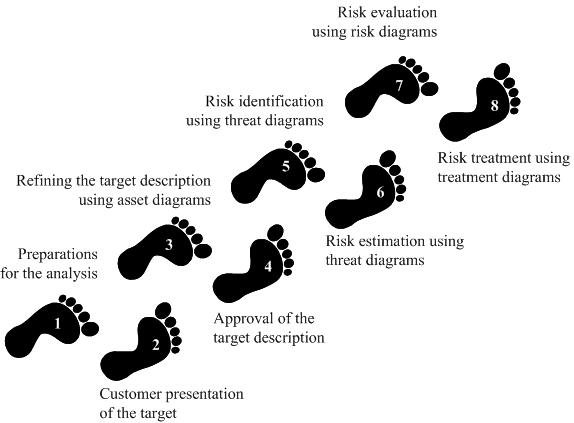
The eight steps of the CORAS method are summarised as follows.
- Step 1: The first step is the initial preparations for a risk analysis. The main objective is to get a basic idea about what is to be the target and what will be the size of the analysis such that we can make the necessary preparations for the actual analysis tasks.
- Step 2: The second step is the introductory meeting with the customer on the behalf of which the analysis is conducted. The main item on the agenda for this meeting is to get the representatives of the customer to present their overall goals of the analysis and the target they wish to have analysed. The objective is to achieve a common initial understanding of the target of analysis, and of what the parties of the analysis are most concerned about. The overall goals of the analysis are put forward, the focus and scope of the analysis are set, and the rest of the analysis is planned.
- Step 3: The thirds step aims to ensure a common understanding of the target of analysis, including its focus, scope and main assets. The analysis team presents their understanding of what they learned at the first meeting and from studying documentation that has been made available to them by the customer. Based on interaction with the customer, the analysis team will also identify the main assets to be protected. The analysis team furthermore conducts a rough, high-level analysis to identify major threat scenarios, vulnerabilities and enterprise level risks that should be investigated further. The outcome of Step 3 is a refined and more detailed understanding of the target description and the objectives of the analysis, which at this point are documented by the analysts.
- Step 4: The fourth step aims to ensure that the background documentation for the rest of the analysis, including the target, focus and scope is correct and complete as seen by the customer. The step involves presenting a more refined description of the target to be analysed, including assumptions and preconditions being made. Typically, the analysts describe the target using a formal or semi-formal notation such as the UML. Before the actual risk analysis starts at the next step of the analysis process, the description of the target should be approved by the customer. Step 4 furthermore includes deciding the risk evaluation criteria for each asset. This analysis step concludes the context establishment.
- Step 5: The fifth step is the risk identification. To identify risks, CORAS makes use of structured brainstorming. Structured brainstorming is a step-by-step walkthrough of the target of analysis and is carried out as a workshop led by the analysts. The main idea of structured brainstorming is that since the workshop participants represent different competences, backgrounds and interests, they will view the target from different perspectives and consequently identify more, and possibly other, risks than individuals or a more homogeneous group would have managed. The risk identification involves a systematic identification of threats, unwanted incidents, threat scenarios and vulnerabilities with respect to the identified assets. The activities are supported by the CORAS language, and the results are documented on-the-fly by means of CORAS threat diagrams.
- Step 6: The sixth step aims to determine the risk level of the risks that are represented by the identified unwanted incidents. The unwanted incidents were documented in threat diagrams during Step 5, and these diagrams serve as the basis for the risk estimation. Step 6 is conducted as a brainstorming involving personnel with various backgrounds, and basically involves the estimation of the likelihoods and consequences of the unwanted incidents. These values in combination yield the risk level for each of the identified risks. The CORAS threat diagrams facilitate the likelihood estimation by supporting the estimation of the likelihood for threats and threat scenarios to cause the unwanted incidents.
- Step 7: The seventh step aims to decide which of the identified risks are acceptable, and which of the risks must be further evaluated for possible treatment. Whether or not the risks are acceptable is determined by using the already defined risk evaluation criteria and the results of the risk estimation. Step 7 furthermore involves estimating and evaluating risks with respect to indirect assets.
- Step 8: The eighth step is concerned with the identification and analysis of treatments. The risks that are found to be unacceptable are evaluated to find means to reduce them. A treatment should contribute to reduced likelihood and/or consequence of an unwanted incident. Since treatments can be costly, they are assessed with respect to their cost-benefit, before a final treatment plan is made.
News
2015-11-16: What were the most important design choices in the development of the CORAS language? Check out the paper The CORAS Language - Why it is designed the way it is.
2015-09-03: A book focusing on risk management and assessment with respect to cybersecurity is now available: A. Refsdal, B. Solhaug and K. Stølen: Cyber-Risk Management. Springer, 2015. See Springer page.
2014-12-19:A new version (v1.4) of the Eclipse-based CORAS tool is now released. It is available for both the 32-bit and the 64-bit versions of Windows and Java, as well as for other major platforms such as Mac and Linux. See downloads.
2014-10-23:Existing standards and established methods and techniques provide little or no support for how to handle the complexity of large systems. Novel techniques for compositional risk modeling using CORAS is presented in a recent paper.
2013-12-28 A new version of the formal semantics for the CORAS modeling language is now available. Whereas the previous semantics was based on probabilities and probability reasoning, the new version supports reasoning about likelihoods using frequencies and frequency intervals. In the practical setting of risk modeling and analysis, frequencies are more adequate and suitable than probabilities. The new semantics can be found in the appendix of a technical report.
2012-10-08 For an introduction to CORAS, Chapter 3 of the CORAS book (A Guided Tour of the CORAS Method) can be downloaded for free from Springer. See also the product flyer for information about the book.
 Follow CORAS on LinkedIn
Page updated November 16, 2015